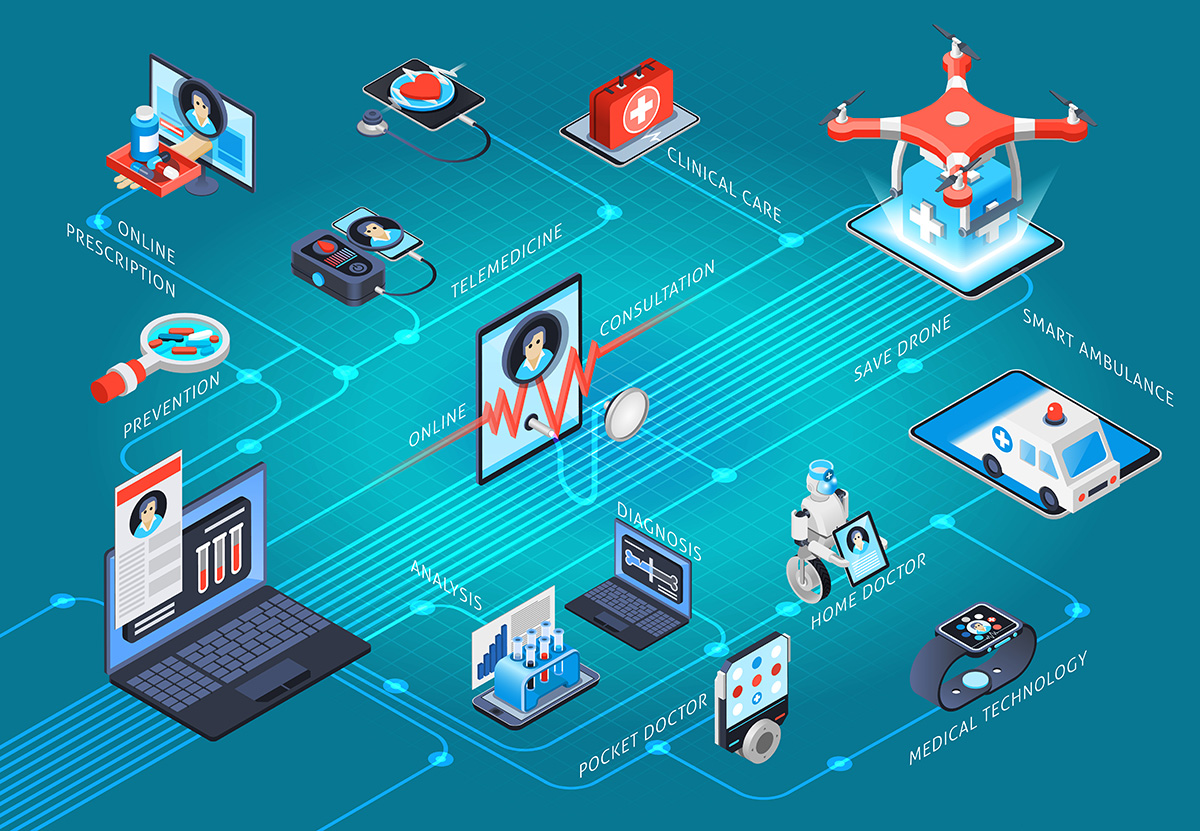
.There is no doubt that Artificial Intelligence is taking over the different industries and also across the different spheres of our lives. While Artificial Intelligence is slowly strengthening its roots in our daily lives, we cannot help but notice the tremendous changes that it brings with it and the greater impact upon societal life. We have seen Artificial Intelligence being tremendously impacting sectors like the service providing sectors, defense, education and even research. Healthcare is one sector that has the potential to benefit greatly with Artificial Intelligence. During the pandemic the healthcare system was exposed to the havoc created by the deadly Covid 19 and several hospitals struggled with the management systems. In the post Covid world, it has been taken into consideration that efficient management systems are to be put in place across all public and private hospitals and nothing does it better than Artificial Intelligence. Chatbot based support systems, Patient tracking, Data management systems, Staff management systems, etc is something that Artificial intelligence can help with.
On the other hand, Artificial Intelligence can also be useful in revolutionizing and producing more precise, efficient, and impactful results and interventions that will be interventions at exactly the right moment in a patient’s care. Artificial Intelligence also offers more detailed and accurate information by interacting with training data and giving major insights into the diagnostics, variations in treatment and results of various tests. Artificial Intelligence has also revolutionized the study of human psychology by creating a direct interface between the brain and technology. This helps in actively mapping the human brain, studying trends and patterns in human behavior and also understanding the cognitive ability of humans. One of the major contributions of Artificial Intelligence is the development of the Brain-computer interfaces (BCIs) which could restore those fundamental experiences to those suffering from neurological and psychological diseases. Artificial Intelligence is also used in developing the next generation of radiology tools that will give a detailed view of the working of the human body rather than only organ specific view and study. artificial intelligence could help mitigate the impacts of staff shortage by taking over some of the diagnostic duties typically allocated to humans. For instance, several tests that can be run on the body such as x-Rays, Ultrasonography and even the report study by using AI and this is the need of the hour in the third world or developing countries where there might be a shortage of staff.
Other important things that AI influences is the management of payment structures as well as generation of prescriptions and inventory management. Thus Artificial Intelligence has a lot to contribute towards the healthcare sector. With the inclusion of AI not only several in detailed analysis can be carried out regarding the various bodily functions and diseases but they can also help in finding out the antidote to such anomalies or at most study and suggest ways to control them.